
Redefining Functional Neurosurgery.
Focused ultrasound offers a non-invasive alternative to Deep Brain Stimulation (DBS) for investigating brain circuitry. By applying low-intensity acoustic pressure to specific nuclei, researchers can excite or inhibit neuronal activity without thermal damage. This application is transformative for preclinical studies on chronic pain, epilepsy, and psychiatric disorders, allowing for the mapping of functional connectivity in real-time within live models.
Our transducers offer the spatial resolution required to non-invasively stimulate or inhibit specific brain regions, opening new doors for treating chronic pain and psychiatric disorders.
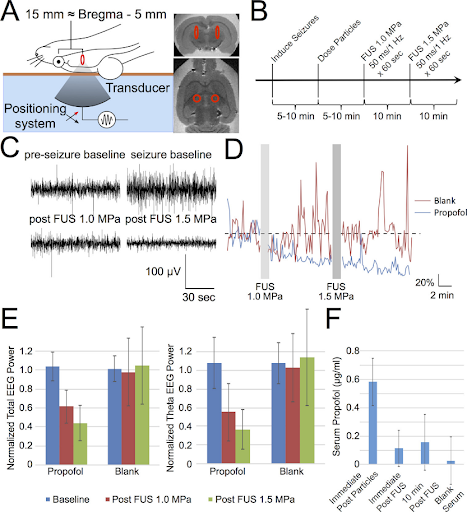
(Top) Schematic of seizure induction, propofol-nanoparticle dosage, FUS application (red ellipse) using MRI-compatible RK-300.
(Bottom) FUS administration first at 1.0 MPa peak pressure and then at 1.5 MPa, significantly silences seizure activity, measured by total and theta band EEG power in animals receiving propofol-loaded particles, but not in the animals receiving blank particles.
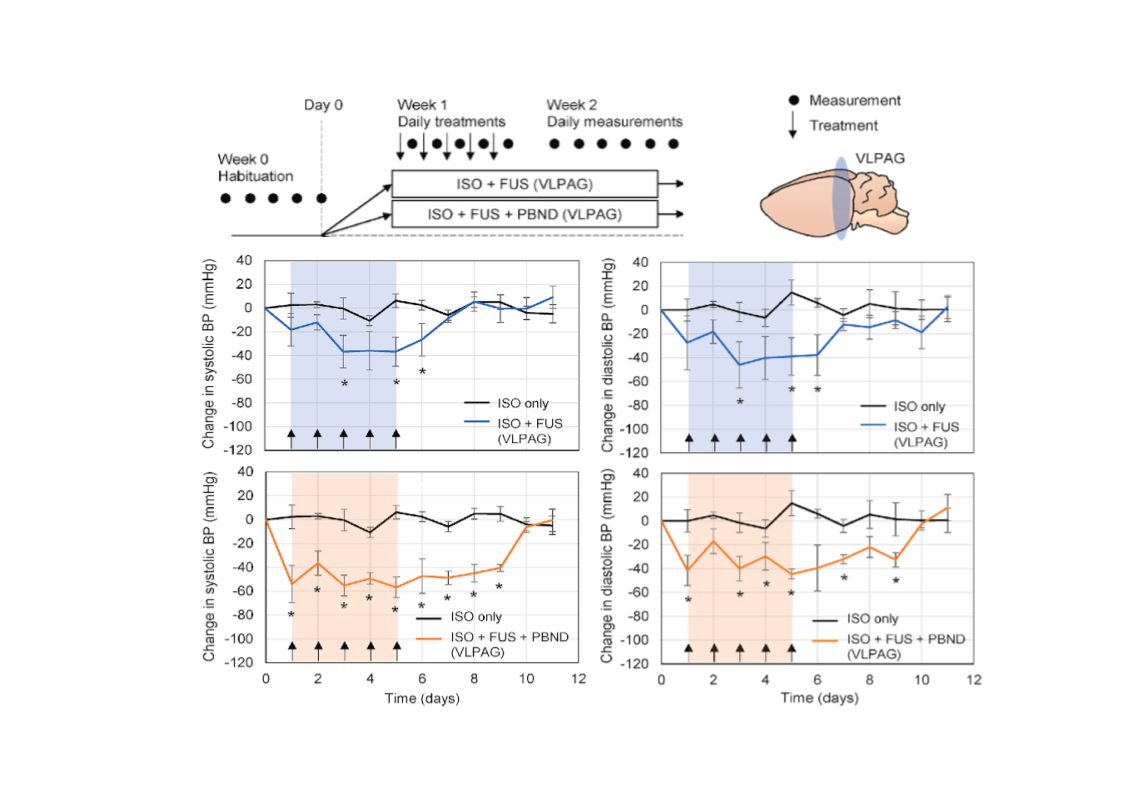
FUS exposure of the brain VLPAG with pentobarbitol-nanodroplet (PBND) in spontaneously hypersensitive rats showed the greatest and most reproducible reduction in blood pressure, which remained significantly reduced for 4 days following the last sonication (p < 0.05).
FUS treatment was administered by a prototype RK-50.
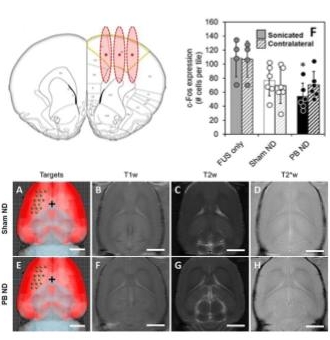
(Top) FUS sonication targets in the motor cortex and subsequent c-Fos expression after pentobarbitol-nanodroplet vaporization without BBB disruption by FUS.
(Bottom) FUS target locations covering the left cortex, T1- and T2-weighted contrast-enhanced images showing intact BBB, no indication of edema or hemorrhage after sonication.